
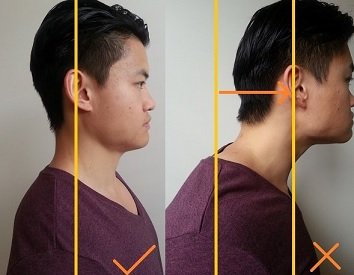
We are currently living through a postural epidemic. While our ancestors evolved to look at the horizon, we spend our days looking at our laps. This constant downward gaze is creating a structural strain on the thoracic spine, leading to what is be labeled as the “tech neck” or “tech hump.”
1. The Biomechanics of the “Tech Neck”
The human head weighs approximately 10–12 lbs / 4.5-5.5 kg in a neutral position. However, due to gravity, as the head tilts forward, the weight and stress on the neck skyrockets.
- 15° Tilt: 27 lbs / 12 kg of pressure.
- 30° Tilt: 40 lbs / 18 kg of pressure.
- 60° Tilt (The Smartphone Standard): 60 lbs / 27 kg of pressure on the neck and upper back.
This “Gravity Tax” forces the mid back (thoracic spine) to compensate by curving outward to support the load, eventually leading to increased rounding of the upper back that can become a semi-permanent hump – Thoracic Hyperkyphosis.

2. From Habit to Hump: Upper Crossed Syndrome
When you spend 8+ hours a day in a “C-shape” (shoulders slumped, chin poked forward), your body undergoes a process called adaptive shortening. This creates a pattern of muscle imbalance:
- The Tight Front: Your pec’s(chest) and upper traps become tight and short, pulling your shoulders forward.
- The Weak Back: Your rhomboids and lower trapezius (the muscles that pull your shoulders back) become overstretched, inactive, and “lazy”.
- The Result: A visible “hump” at the base of the neck, which the body develops as a protective padding against the constant strain on the vertebrae.

3. Hacking Your Tech Habit
Since we can’t exactly throw our iPhones into the sea, we have to change how we interact with them.
| The Tech Trigger | The Correction |
| Smartphone Scrolling | The T-Rex Rule: Keep your elbows tucked into your ribs and bring the phone up to eye level. Minimise looking down into your lap. |
| Laptop Slumping | The External Pivot: Use a laptop stand and a separate Bluetooth keyboard. Your screen must be at eye level to prevent letting our head hand forward. |
| The Deep Work Hunch | The 20/20/20 Reset: Every 20 minutes, look 20 feet away for 20 seconds, and squeeze your shoulder blades together to re-engage the back muscles and reset your posture. |

4. Reversing the Curve
If you’ve noticed persistent stiffness in your neck and upper back, as well as a “hump” forming, you need to transition from passive sitting to active recovery.
- Back Bridges: Use a foam roller or a “yoga wheel” and extend your mid and upper back over the roller while taking a breath out. This provides a passive stretch that counters the “C-shape.”
- Wall Angels: Stand with your back against a wall, trying to keep your head, shoulders, and glutes in contact with the wall. Move your arms up and down like a snow angel. This is a “diagnostic” exercise—if you can’t keep your head against the wall, the hyperkyphosis is already progressing.
- Exercise and resistance training: performing back engaging exercises such as a row, lat pull down, pull ups, inverted rows, cable face pulls, will strength and activate your back muscles to pull your shoulder blades back and improve your posture.
- Massage and Chiropractic care: These hands on therapies can relive muscle and joint restrictions to reduce aches and stiffness caused by tech neck, to ‘reset’ your posture and allow you to stand more upright.
The Takeaway
Your spine is a moldable structure; it molds to the shapes you put it in most often. Small changes to daily habits will help prevent and reduce the stress on your neck and upper back to provide long term relief.
Leave a Reply